Essay 001
Why Albania's Reputation Is Kosovo's Biggest Problem
The Cost of Being Mistaken for Someone Else.
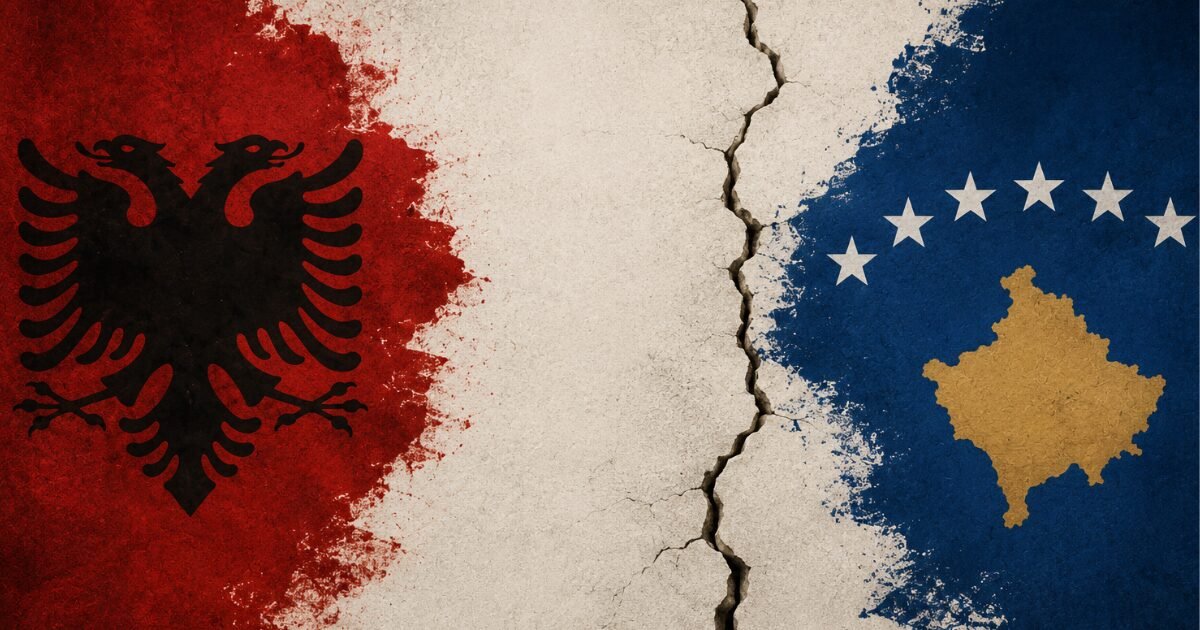
For most of human history, a name told you who to trust and who to fear before the person opened their mouth. It still does.
If you ask a German, an Italian, or a Brit what comes to mind when they hear the word “Albanian,” you’ll usually get the same answer: mafia, trafficking, corruption, and nepotism. Ask the same people to name one true thing about a Kosovar, and watch the confusion. Then they usually mix it up with Serbia, or ask if it’s “basically Albania.”
Most of us believe reputation is earned over time: you build it, you ruin it, you live with the consequences. But reputation doesn’t always work like that. Sometimes, sheer proximity is enough to shape how people view you, without you doing anything in particular. Between Tirana’s corruption headlines and Pristina minding its own business in silence, an entire nation is paying for a reputation it never benefited from.
And I’ll never forget the first time I was on the receiving end of that.
At 19, I moved from a small city in Bavaria to Hamburg to start university and, a few weeks in, took a job at a hotel near the airport. In the first few days, I got along well with the team, but I kept running into a wall with one specific employee who had been friendly before, but it abruptly stopped one day. Eventually, during a morning shift, I walked over and asked him directly if I had done something that pushed him away. He looked at me in a way I remember looking at my father when I was a child, and said, “I just don’t want any trouble with you people.” He didn’t even dare to look at me; he kept organising the cheese platter for breakfast, starting at 7am. I was confused, so I asked: “What people? I don’t understand.”
Very carefully, as if he didn’t feel safe enough to say it: “The Albanian Mafia,” he whispered and took the cheese platter out.
I can’t tell you how long I stood there in disbelief at what just happened.
On the same day, another coworker explained to me that - allegedly - the whole Reeperbahn in Hamburg is run by the Albanian Mafia, which he apparently referred to. The question of who I am was already answered before they ever talked to me.
Later, I had another chance to talk to him. Since I had always made a clear distinction between Albanians and Kosovars, I hoped it would help this time as well. As soon as I said, “I just want you to know that I am from Kosovo, not Albania. I have no connections there — I've actually never even been there,” I saw his body and face relax almost instantly.
Nineteen years old, standing in a hotel kitchen at 7am, and the solution to being suspected of organised crime turned out to be two words: 'from Kosovo.'
Living in Germany, I was used to being viewed as a refugee and a foreigner my whole life; my first and last name are very obviously non-German, and my blue eyes were treated as a kind of exotic detail for as long as I remember. I was used to all the comments on my last name, the ‘where are you really from?’ question, and all the religious prejudice, especially after 9/11. But the mafia association was something else entirely – it wasn’t about where I was from. It was about what they assumed I was capable of.
Every nation, every religion, every ethnicity has done this – attached a reputation to people through sheer proximity, or handed it down by birth with no wiggle-room for change of direction. Kosovo was one of the last nations that fell back on an ethnic identity, at a time when the concept of a civic identity simply wasn’t as common in the Balkans.
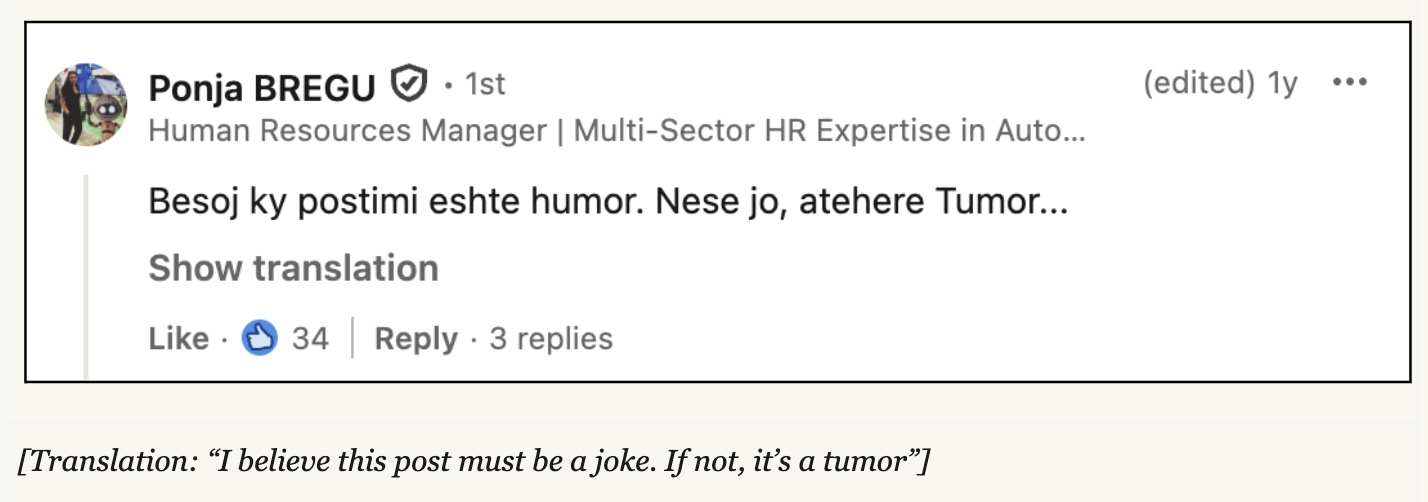
In April 2025, I posted a simple poll on LinkedIn – “Are you Albanian or Kosovar?” I didn’t expect it to go viral on a professional platform, but it did. Within hours: aggressive messages, rape and death threats, over a hundred connections removing me from their networks – one even implying this post must be the result of a tumor.
But the threats weren’t what stayed with me. A specific kind of comment was: “Kosovo doesn’t exist.” “You speak Albanian, so you’re Albanian.” “Only our minorities call themselves Kosovar.” “If you really knew our history, you’d know what you are.” And – perhaps the most revealing of all – that I was being ungrateful for everything Albania had done for us.
These weren’t comments from Germans or Italians who don’t know anything about the Balkans. These were people of Albanian ethnicity, many of them Kosovar, telling me I didn’t know what I was. That my identity was either invalid, delusional, or a betrayal of where I came from.
So it’s not just foreigners confusing Kosovars with Albanians. The confusion lives inside us, too.
But not in all of us, it turns out. A few weeks ago, my niece decided she needed to paint my fingernails — pink and brown with purple glitter, her choice, not mine. I was mid-sentence: 'You know, as a female Albanian, it's a bit difficult to...' when she didn't even look up from my hand and corrected me with a smirk: “But aunty, we’re Kosovars, not Albanians,” and kept painting as if I said something totally unremarkable. For three years I’ve been researching a question my niece didn’t even deem worthy of attention.
Despite the exploitation that came with the refuge Albania offered in 1999, for a long time we assumed Albania felt about us the way we felt about them. That veil is slowly lifting, too. A friend of mine from Prishtina, recently came back from a weekend at Durrës with his wife and kids, and then shared something I had heard many times before, but never this clearly, he said: “We arrived and were greeted with 'ahh, our brothers have arrived!’, but the moment we actually acted like brothers – like we naturally belonged there – we were reminded that we were just another tourist like anyone else, too. The connection was real as long as it didn’t demand anything from them. I think it’s just in our heads,” he said, as if it hurt him to say it out loud, “not even in theirs.”
A few months after my LinkedIn poll, I posted my first TikTok video with the statement “Kosovo isn’t Albania – that’s not a problem, that’s just a fact.” And again, it went viral. 9,300+ hate comments in 48 hours — just louder, more unfiltered, including one who called me our nation's ‘number one enemy.'
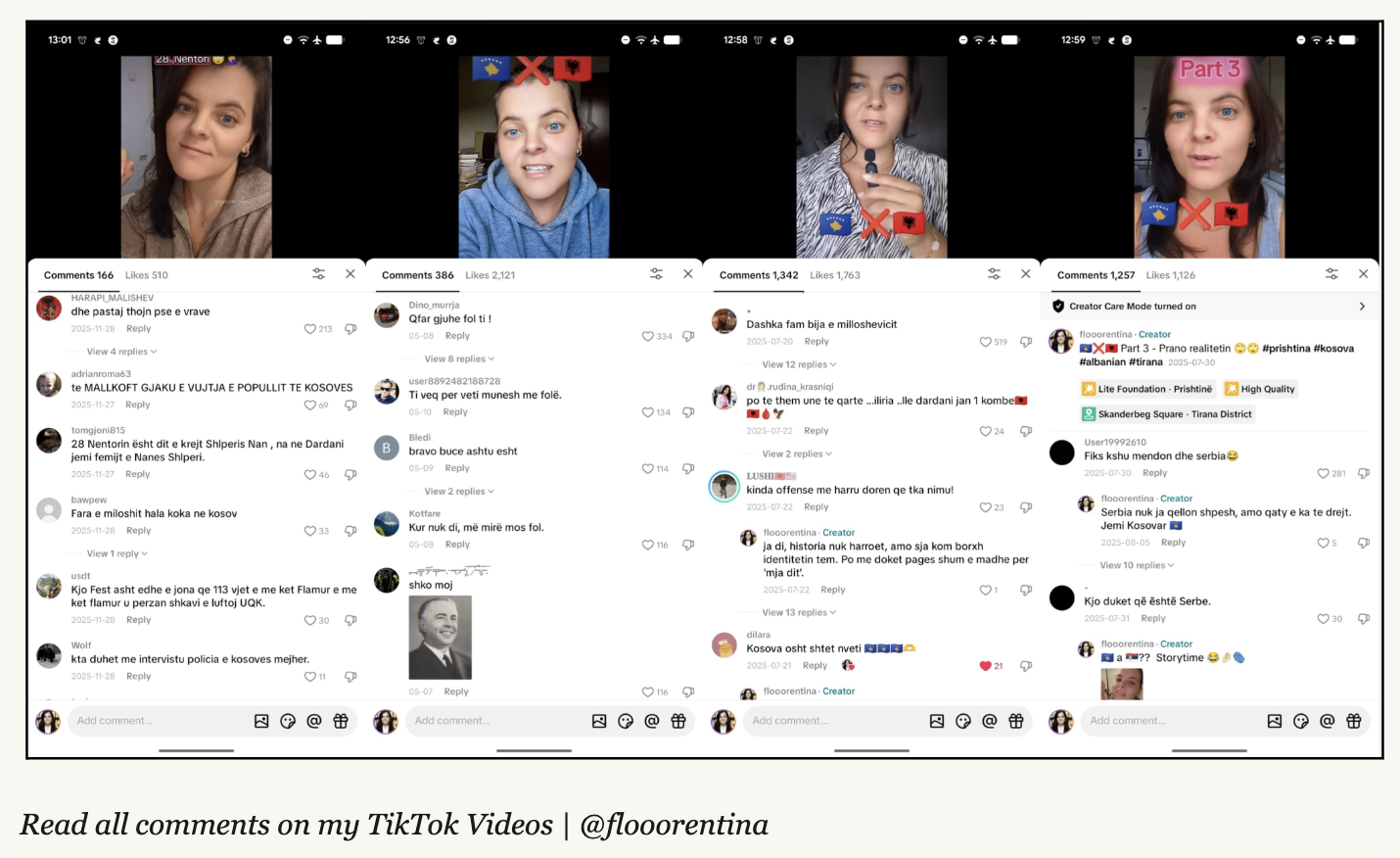
When a German, an Italian, or a Brit can’t differentiate between Albanians and Kosovars, that’s a reasonable ignorance – the world is large, and Kosovo is small by more metrics than one. But when Kosovars can’t either, that’s a national problem.
Global confusion is a logical extension of our own.
But it’s deeper than that. My sister has worked at hotel receptions for years now; a few months ago, she told me about an interesting incident. She got into a conversation with two guests who mentioned they were travelling to Kosovo next. Naturally, she started giving recommendations. They were very thankful to her and mentioned proudly that they'd already exchanged over 500€ into Albanian lek for a four-day trip to Kosovo. First, she was confused but assumed they also planned to go to Albania next, which is common for anyone visiting the Balkans, so she continued to recommend the south-west coastline for beach days and Valbona for hiking, but then they interrupted her and said: “No, we're not going to Albania at all.” Turns out they assumed Kosovo was part of Albania, but not its own country. More like a region. This global confusion costs Kosovo far more than we like to admit. On one hand, we like to claim that hospitality is a strong suit of ours, yet we conveniently forget that a great experience starts before tourists even arrive. Global confusion has a measurable price, monetarily and emotionally.
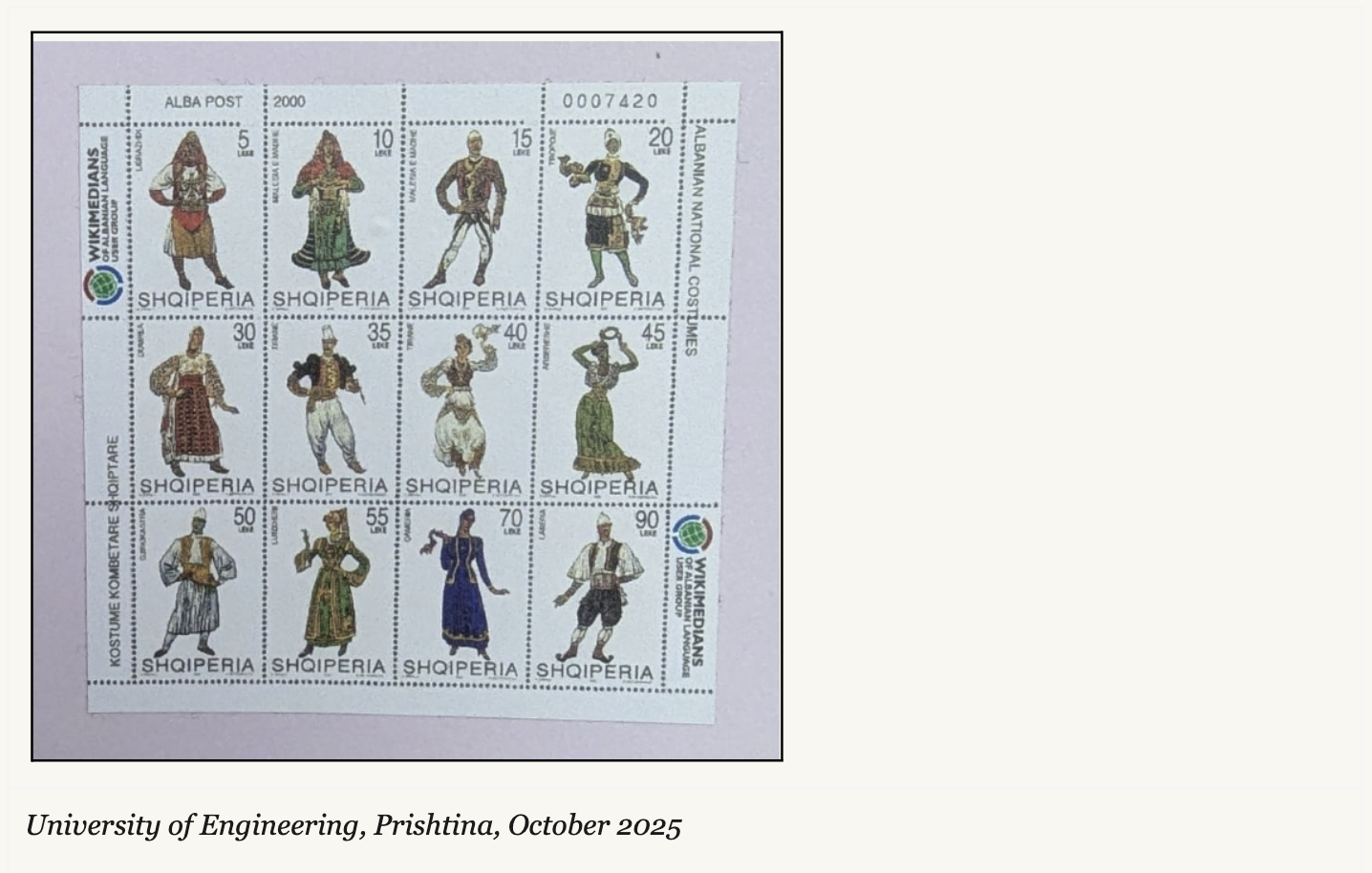
In October 2025, I attended an AI and technology event at the University of Engineering in Prishtina. The Prime Minister gave the opening speech about Kosovo's future in the digital sector. At the stands, the branded merchandise was overwhelmingly Albanian-flagged — the eagle, the Albanian flag, 'Albania' printed everywhere. One stand even had custom postage stamps. Twelve of them. Each one reading SHQIPERIA (ALBANIA). I was so taken aback by it that I had to take one home.
Just imagine the dozens of times across the ideation and production process someone — probably Kosovar — had to make a conscious choice about this wording. If you look at the small print on the sides, you see that the stamps were about the Albanian language, not the Albanian state — so it should have been "Shqip," not "Shqipëria" anyway. But nobody bothered to make that distinction either. The confusion at that event wasn't about politics or nationalism – I truly don't think they had a deliberate agenda – but that makes it worse. It was simply a habit of ours I had seen many times before. But these kinds of habits are exactly where national identity and global reputation are built or lost — and isn't that the whole premise behind all the habit-optimisation content available online — that habits don't just reflect who you are; they decide who you become?
Proximity to someone or something always impacts how people or nations are viewed — credibility, or loss of credibility by association, is a real thing. North and South Korea share a language, a peninsula, and a history going back centuries, yet still have two of the most distinct reputations on earth. So no, reputation doesn't fully transfer from one nation to another just because we speak the same language or because we're close to each other — but it's also not entirely disconnected from one another.
Albania’s negative reputation is more a result of historical consequence than a cultural trait. My whole life, I heard “Oh, that’s just how we are,” while never clarifying who “we” is. Simplifying something so complex is exactly why nobody takes responsibility for anything. We tend to forget that Albania was isolated from the world for thirty years – total isolation, total surveillance, agency erased at the root, simply put: communism. Thirty years of that would get the best of most nations. Not just Albanians. When the system collapsed in the early '90s, there was nothing truly healthy or stable underneath it. No functioning institutions. No rule of law. No moral compass guiding its people, because even that was set by Enver Hoxha. All that was left was a nation rebuilding in the only ways they knew how – informal, fast, and often illegal. Sali Berisha’s government then pushed a nation from communism towards capitalism with no other long-term vision than “away from communism”.
There's a silent loyalty among ethnic Albanians everywhere — in Kosovo, in North Macedonia, in South-East Montenegro, in the west of Greece, and even in parts of southern Serbia — an unspoken rule that you don't distance yourself from the ethnic identity, let alone question any potential consequences of that blind loyalty. We're expected to carry Albania's reputational burden as if it is ours. Albania, in return, claims every one of our successes as its own — regardless of which country that success actually belongs to. Apart from the fact that this is a very one-sided century-long win for Albania, do you know what this reminds me of? A picture-perfect situationship. Albania gets the upside — our diaspora's sense of belonging, our loyalty, our global successes claimed under their flag and name. We get the downside — the global burden of being mistaken for someone else, the one that’s always forgotten, and none of the real commitment at all. And the moment we ask for something back, we’ll get a very diplomatic answer of why it’s not possible right now. And if we learned anything from situationships, we learned that ‘right now’ actually means ‘ever’.
Albania needs to grow up and hold its own hot potato. Our hands are busy holding our own.
The world cannot and should not compare Kosovars to Albanians. Kosovars never fully had a state that was unambiguously our own responsibility. That is a very different past, a very different underlying psychology, a very different long-term impact on our nation, and a very different current reality. Therefore, we simply can’t have the same reputation.
There's a more precise reality we should name underneath all of that. Kosovo was never simply taken. It was passed — moved from one hand to the next. The Ottomans. The Serbian Kingdom. Yugoslavia. Milošević's Serbia. The UN. Each one redrew the borders on a map with us inside it. A whole nation was treated like a pawn on a chessboard: we were moved first, and sacrificed most casually. For decades, we were collateral damage in someone else's endgame.
Since 1990, 34 new countries have been established – almost all from the breakup of larger ones. Every single one faced the same question immediately after: who are we now, and where are we going? Kosovo is not an exception. We’re just one of the latest nations with a problem as old as nationalism itself.
When Dua Lipa – born in Kosovo to Kosovar parents – donated one million euros to Kosovo’s youth education system, many in our own regional media outlets called her Albanian.
Not Kosovar. Not of Kosovar descent. Albanian.
The cause she gave was explicitly, specifically, in Kosovo. And yet the story ran under the narrative of her being Albanian.
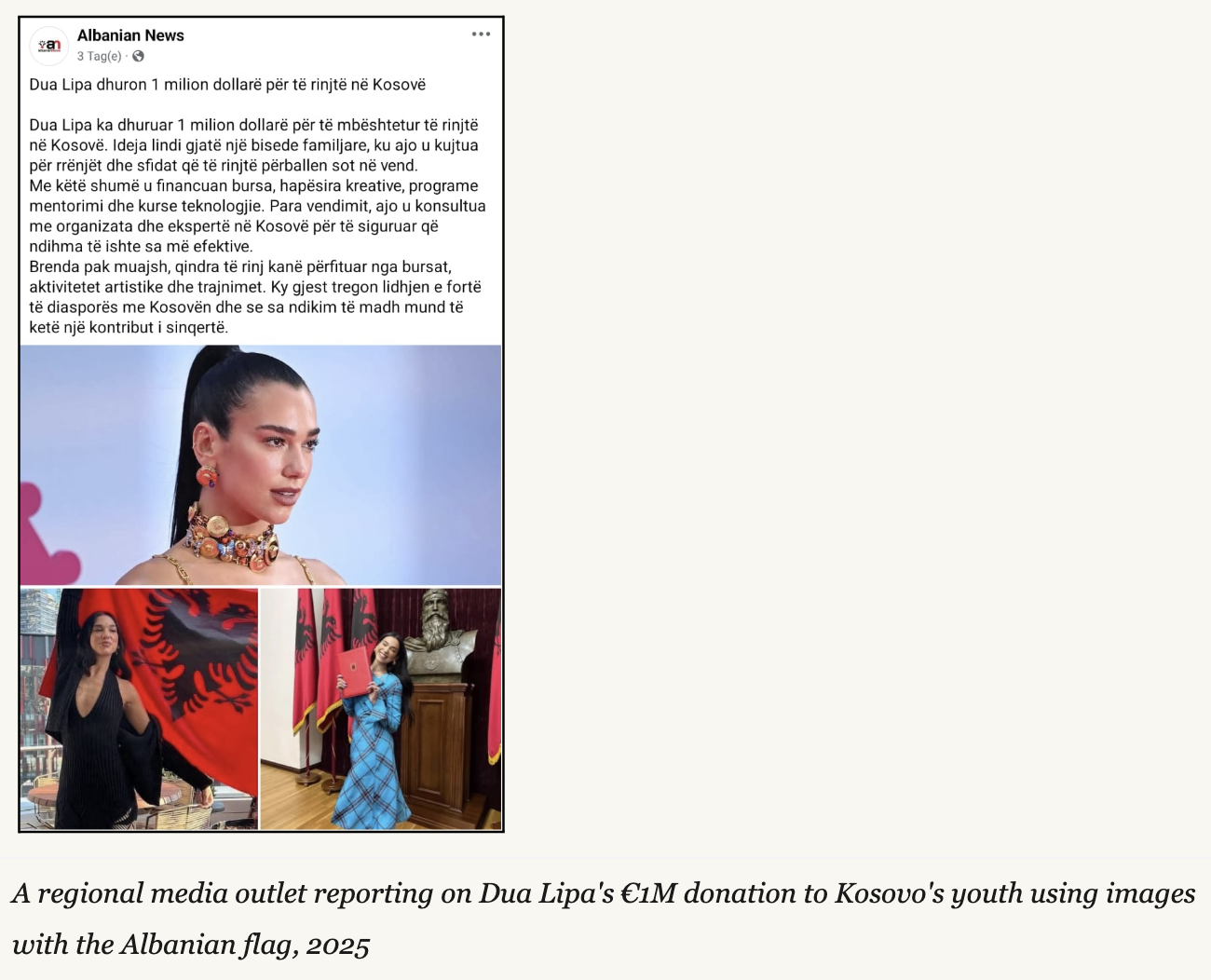
We cannot wait for the world to draw the distinction between ethnic and civic identity if we won’t insist on it ourselves. Dua Lipa, Rita Ora, Granit Xhaka, and Xherdan Shaqiri are, by how modern societies define identity: civic-based, not ethnicity-based – Kosovars, not Albanians. Yes, including those who’ve made the double-eagle gesture publicly or chose to use the Albanian flag emoji instead of Kosovo’s on their Instagram bio. Identity and the performance of identity aren’t always the same thing.
The diaspora version of this identity question is messier than the local one. A Kosovar born and raised in Kosovo is navigating between feeling Kosovar and Albanian. A diaspora child is navigating among Kosovar, Albanian, and the place where they spend the majority of their life — Germany, Switzerland, or elsewhere. Sometimes those three coexist. Sometimes they’re in direct conflict. I don't know what the final version will look like for me — and maybe I never will. I just know the answer can’t simply be, "Pick the Albanian flag because that represents your ethnicity.”
Every time we call ourselves Albanian, use the Albanian flag, or do the double-headed eagle sign, we promote Albania and harm Kosovo by (un)intentionally strengthening their international recognition while weakening our own national brand – directly and indirectly. Shared identity ≠ shared economy. Refusing to acknowledge our existence costs us media attention, tourism, celebrity attribution, international recognition, cultural exports, and more. All of which are very measurable consequences.
Our recent political pattern of the government and the opposition blocking each other for over 16 months, leaving a whole nation without a ruling government and parliament, suggests that we haven’t fully decided yet whether we truly want autonomy or just like playing with the idea of it — because it keeps us busy performing European values for an audience that kept us waiting for visa-free entry until 2024. But true autonomy always has a cost.
We treat reputation as a form of branding when in reality it behaves more like infrastructure: Roads determine how easily goods move. Stable institutions determine how easily societies function. A positive reputation determines how naturally opportunities arrive.
The perception of Albanians around the world isn’t ours – but we categorised ourselves inside it because many truly believed in uniting with Albania sooner or later, despite the low probability. And on a smaller scale, we all know how standing next to someone, even in symbolism, feels more secure than standing alone.
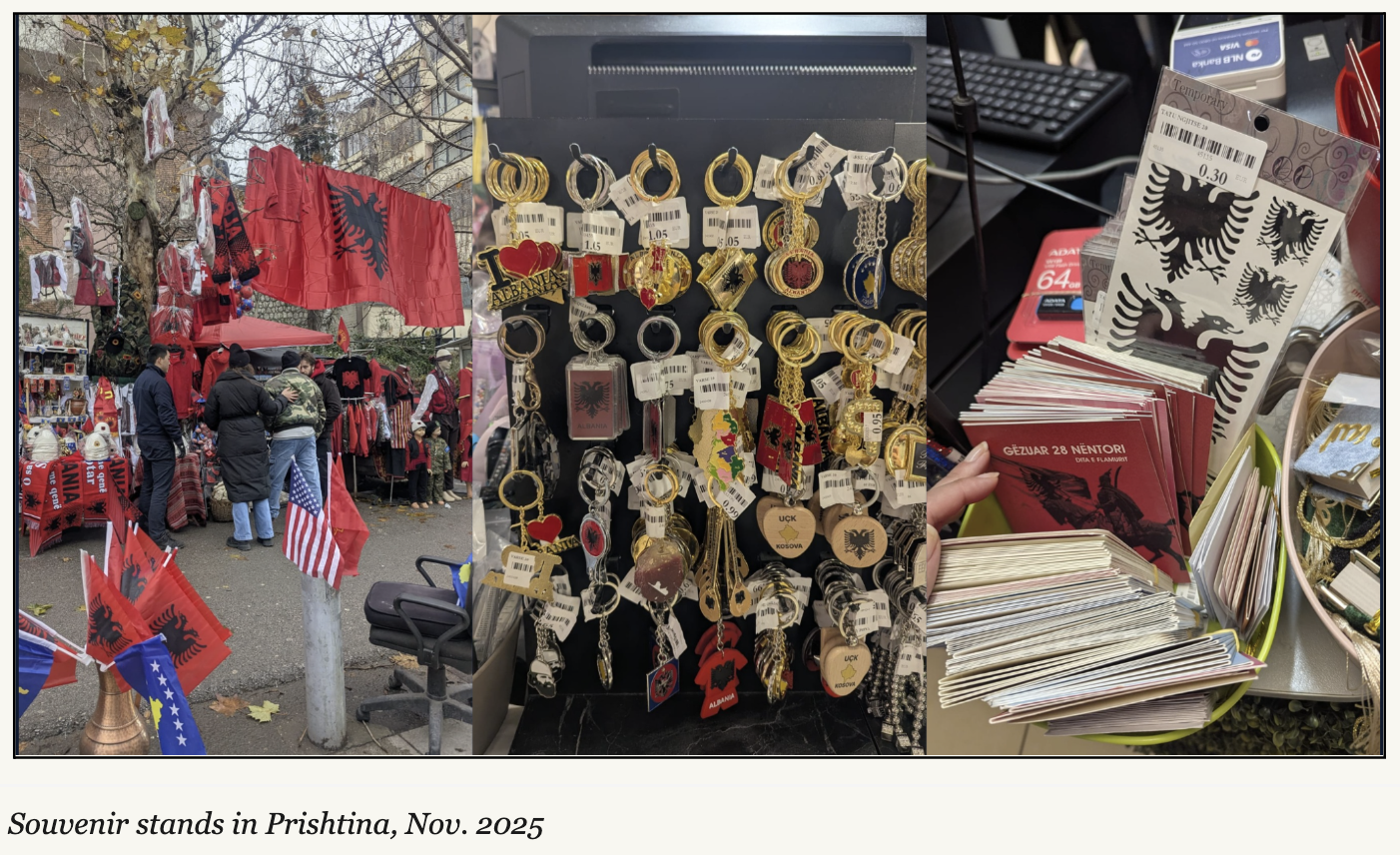
We forget that Kosovo doesn’t have a bad global reputation. – It doesn’t have one at all.
Contrary to what most people believe, not having a reputation at all is an amazing position to be in. A bad national reputation takes generations to improve. But lacking a reputation completely? That is a gift. That is an opportunity.
Over the last three years, I’ve started thinking about national identity and reputation as two separate systems that constantly influence one another. Identity shapes behaviour. Reputation shapes opportunity. When you combine them, four very different situations emerge. Sometimes the two align. Sometimes they couldn’t be further apart from each other.
To make this distinction easier to think about, I developed what I call The Recognition Gap Framework™.
The Recognition Gap Framework™
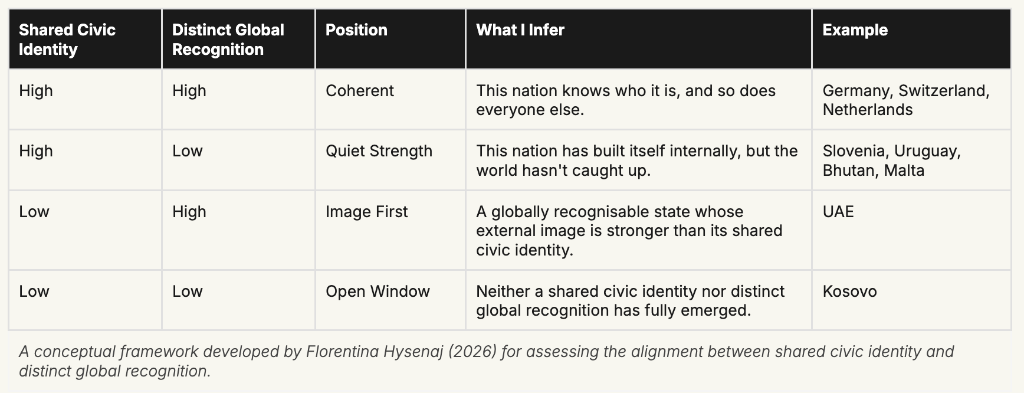
Kosovo is one of the few countries still sitting in the fourth category, because neither our identity nor our reputation has fully solidified yet. That creates uncertainty, but it also creates a one-in-a-century possibility. A nation's position inside The Recognition Gap Framework™ is not permanent. Countries can move between quadrants over time as identity evolves and global recognition changes.
Before 1965, nobody had a strong opinion about Singapore. The world simply had no reason to care. Singapore is now known for its competence, Switzerland for its trust, and despite 88% of its nation being foreigners, the UAE for its ambition — proof that distinct global recognition doesn't always require clarity of a shared identity. More than anything, it requires a decision to commit to one clear direction first.
So where is Kosovo going?
Our problem isn’t just an absent shared identity. It’s that, instead of developing our own, we inherited someone else’s. That’s a different problem. And it requires a different solution. We can’t start building something new without deliberately detaching from something old first.
Remember the pawn from earlier? In chess, it's the only piece on the board that can become anything if it stays in play long enough to reach the other side. After 27 years, Kosovo is still on the board.
As a nation, we have the biggest benefit of all: A country is young enough for us to paint a clear picture of who we are, internally and globally — but these kinds of open windows won’t stay open forever.
These windows start closing after the first generation.
If you start counting from 2008, we’ll hit that window approximately in 2028. Advancing requires letting go of the past as your main identity. The faster, the better. Collectively, we need to agree on two things: one, we’re too far away from war to still use it as an excuse for our lack of accountability for where we are today, and two, we’re very far away from calling ourselves truly sovereign, because we keep avoiding uncomfortable but necessary choices and conversations due to our obsession with maintaining superficial harmony. We’re in the in-between.
You know what they say: it takes one to know one. Like many diaspora kids, I spent most of my life in the in-between. I recognise it because I've lived inside it all my life. We never got a clean answer to “where are you from” – we get two cultures, and the permanent feeling of being slightly outside both. At one point, I just stopped expecting to arrive at a final version of myself and instead chose a path, not a destination. That kind of fluidity during a journey is normal. It’s even healthy. But fluidity is very different from having no direction at all. Uncertainty about who you’re becoming is not the same as having no vision for where you’re going.
Kosovo has the first – but as a nation we’re not on a clear path; there’s no vision for where we’re going.
Having a promising sector isn’t the same as having an economic vision. Economic growth that excludes the majority of your population isn’t a national vision – it’s a privilege for a few. What Kosovo needs is a vision tangible to everyone, not just the ones with a laptop and a LinkedIn profile.
An American Peace Corps teacher I met at a café in Prishtina told me about a parade they took part in during a class trip to another country, where the students had to represent Kosovo. During the parade, a girl told him: 'This is the first time I've ever waved Kosovo's flag.' She was grinning the whole way; he told me that even after one year of volunteer work, he had never seen so much pride in the kids’ faces. I asked if someone had put these words in her mouth by asking a leading question or similar. He said: “No, she told me out of nowhere, before I realised how special the moment was for her.” What looks like a sweet interaction is, to me, one of thousands of signals pointing to something much larger: a generation beginning to imagine a different future. A future Kosovars never really saw for themselves – one that is ours.
Viewing these micro-moments in our society as isolated moments between two individuals feels irrelevant to the bigger picture, but they're not. They compound into beliefs that later shape classrooms, workplaces, relationships, entrepreneurship, and ultimately whether people decide to build a future here or somewhere else. My professional network in Kosovo mostly includes senior management and founders, a few politicians and journalists, and people across the ICT sector. The number one complaint from senior management and founders specifically is brain drain. Most of them don’t understand why it’s so difficult to convince people to stay, despite offering above-average salaries and other corporate benefits. Some even expressed work ethic and delusional expectations as real problems attributed to a ‘lazy new generation’. But the answer closer to the actual reason why brain drain is so difficult to reverse is very simple, and it has almost nothing to do with what companies offer their employees:
No country can retain someone who wasn’t taught to develop a sense of agency over anything, not even their own nation.
Individuals rarely sacrifice for something they do not feel part of - not a partner, not a business, and neither a nation. A generation that never understood why Kosovo is worth staying for or caring for will find its own reasons to leave, and it won’t need many. Identifying with a nation isn’t abstract. It shapes whether the next generation feels accountability towards Kosovo and its economic and political future. It influences whether women feel this is a country where they'd want to raise children, or whether they'd rather build that future somewhere they feel supported, safe, and valued. It influences where men choose to invest their effort too. Many grow up believing that part of their role is to build, whether that's a career, a business, a home, a family, or simply themselves. The question is where they believe that effort will matter. People rarely commit to places where they feel invisible. They naturally commit to places where they feel respected, needed, and like they belong – in more aspects than one. Our basic human need for belonging is very simple, but politicians like to make it sound complex and exhausting. Especially post-crisis politicians.
History shows that big global events don't just project identity outward — they build it inward. The Olympics, Eurovision, the World Cup: for small nations, these aren't just moments of global visibility. For many it’s the first time a population gets to feel collective pride of where they’re from. Kosovo experienced this already once. When Majlinda Kelmendi won Kosovo's first Olympic gold medal in the first hours of Kosovo's first Olympic Games in 2016, something happened that no policy paper had managed in eight years of independence. People watching from Prishtina to New York were cheering for the same flag — for many of us for the first time.
Kosovo hosting the Mediterranean Games in 2030 is another big moment like that. The world will be looking, and from what I’ve heard so far in Prishtina, our nation is very excited for the world to finally see how relevant we truly are. While visibility is important, it alone does not form a long-lasting identity. Global presence alone is not identity. Even sovereignty alone won’t guarantee identity clarity from within. Identity clarity has to be built deliberately, from the inside out, by local people first. And that is the work that has barely started. Now, approaching 2030, this is indeed a real trial for our nation. What are we really able to build when we get trusted to do it? We have a one-in-a-century opening soon, and we won’t be able to blame anyone but ourselves if we don’t make the best out of this historic moment.
Individually and on a national scale, nobody wants to simply be tolerated, let alone dragged along out of sympathy. Everyone needs to belong to something, to someone, ideally to a place that claims them back.
When a country understands how to make its own people feel a sense of belonging towards its nation, its reputation abroad stops being a problem. It becomes a global extension of everyday reality.
I know exactly where I belong. I know which country shaped me, which wounds are mine, and which nation I want to contribute to.
If we ask the same German, Italian, or Brit in 15 years about one fact on Kosovo, I want a stand-alone reputation about us - not Albanians - to be in their minds. One we built ourselves before someone else builds it for us again.
What do you think Kosovo should be globally known for in 2050?
Send me your thoughts on this essay
100% anonymous. If you'd appreciate an answer, leave your email or LinkedIn URL inside the message.
Reader Vote
What shapes a small nation’s identity more: recognition from others, or recognition of itself?
Vote to see how others answered.
Read These Essays Next
Continue Exploring This Topic
- VideoKosovaren sind KEINE Albaner - Erklärt — Florentina Hysenaj
- Research⁉️ Take Our Survey — ☝️🤓 Please only participate if you're from Kosovo.
Go deeper with Identity Insights
If this essay challenged the way you think, you’ll probably enjoy what happens before these ideas become essays. Identity Insights is my private research notebook where I share:
- •unfinished ideas
- •research notes
- •discarded hypotheses
- •diagrams
- •evolving frameworks
- •voice notes
- •field observations
- •book excerpts
- •monthly video discussions
- •behind-the-scenes thinking that never appears publicly
1–2 emails/month. Lifetime access from €1/month. Cancel anytime.

